MobAI: From Copilot to Team Pilot
Move from individual AI use to shared delivery of value
Many organizations are introducing AI one person at a time. That can help individuals move faster, but complex work is rarely only an individual productivity problem. It depends on shared context, judgment, coordination, learning, and decisions across people.
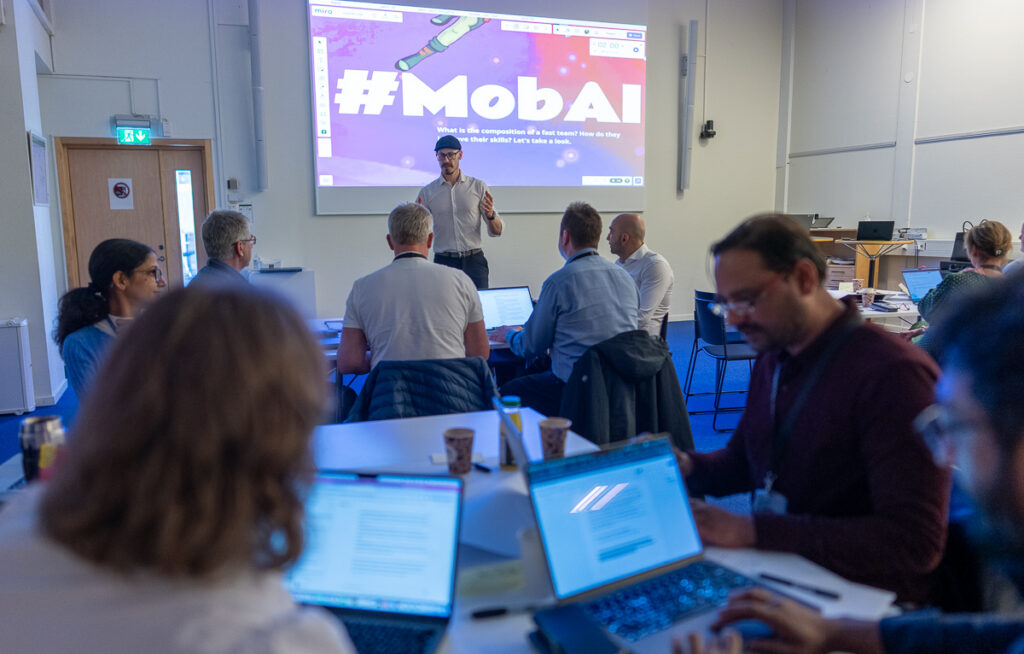
MobAI is a practical format where teams use AI together on real work. The goal is not better prompting in isolation. The goal is to help teams build knowledge, reduce coordination waste, and deliver more value together.
Why this matters
AI adoption often starts privately. One person gets a copilot. Another learns better prompts. A third builds a small automation. That can create real value, but it can also make work less visible. More output appears, while assumptions, decisions, risks, and context stay scattered across individuals.
The organization may look more productive while teams become harder to align and learn from.
MobAI explores another path: AI as part of shared teamwork, with human judgment, local context, and collective ownership around the work.
MobAI brings the work back into the room.
What MobAI helps change
Many teams have Agile roles, ceremonies, boards, and planning routines, but still not real team-based delivery. Experts become bottlenecks. Meetings multiply. Work moves through handovers, dependencies, and local decisions.
MobAI helps teams shift:
- from expert bottlenecks to shared delivery
- from Agile overhead to real teamwork
- from tool adoption to business value
- from token maximization to knowledge building
The setup can be simple: a driver, a navigator, a mob, a real challenge, shared AI, and short reflection loops. The focus is not ceremony. The focus is flow, learning, and value.
What MobAI is
MobAI was coined by Joe Justice after observing AI-assisted group work at Tesla. It builds on mob programming, also called software teaming, popularized by Woody Zuill.
In a MobAI event, a team works together on a real challenge with AI visible in the shared workflow. The team adds context, explores options, reviews AI output, tests assumptions, makes decisions, and feeds new learning back into the next round. When useful, the team can also use its own documents, decisions, lessons learned, and domain material, so AI becomes less generic and more useful.
This is different from one person prompting while others watch. It is also different from everyone using separate AI tools in parallel and stitching the results together later. MobAI treats the team as the unit of learning.
A good fit for internal company events
A MobAI event is useful when an organization wants to explore AI in a practical, team-based way.
It fits teams and leaders who:
- are already experimenting with AI, but mostly at the individual level
- want to use AI on real work, not only in training exercises
- want to move from expert-dependent delivery to shared ownership of value
- need better shared understanding across product, technology, business, design, operations, or leadership
- have many coordination meetings, Agile ceremonies, or artificial roles but too little shared work
- want to surface assumptions, risks, and open questions earlier
- want to connect AI adoption to real customer or business value, not only tool usage
Recommended format
The strongest entry point is often a one-day internal MobAI hackathon.
Many organizations already run hackathons. MobAI can help take those hackathons to the next level by adding clearer team structure, shared AI use, better context, and reflection loops that turn activity into learning and value.
MobAI is broader than hackathons, but a full-day hackathon gives the team enough time to work through several cycles, build local context, reflect on the output, and turn learning into a concrete next step. It is not a competition for the best AI-generated prototype. It is a structured learning event around meaningful work.
Two practical formats
Taster session, 2-3 hours
For leaders or teams who want to understand the shift from individual AI use to shared AI work. Useful as a first conversation or decision-making taster before planning a full-day event.
Full-day MobAI hackathon
Best for complex product, technology, or organizational challenges where the team needs time to build context, work through several rounds, reflect, and define a next experiment. This is the recommended format when the goal is real experience, shared learning, and concrete next steps.
What happens during a MobAI event
The team brings a real challenge. We frame it, capture relevant context, and use AI as part of the shared workflow. The team works in short cycles. After each cycle, we pause and ask:
- Are we heading in the right direction?
- What did we learn?
- What needs human judgment?
- What is missing?
- What new insights and context should we feed back into the AI?
Then the next cycle gets better.
The point is not to remove humans from the loop. The point is to make the human loop better.
Typical outcomes
After a MobAI event, participants have:
- practical experience of AI-assisted teamwork
- meaningful progress on a complex challenge
- a clearer shared understanding of a real challenge
- surfaced assumptions, risks, and open questions
- better local context for continued AI use, including how their own knowledge can make AI more useful
- a concrete next experiment or next step
- a clearer path from AI use to delivered value
What makes it different from ordinary AI training
Most AI training focuses on tools, prompts, and individual productivity. MobAI starts from the work. The team brings a real problem and uses AI in the shared flow while the people in the room apply their own judgment, domain knowledge, and experience.
That shifts the measure of progress. The question is not whether people generated more material with AI. The question is whether the team built knowledge, reduced uncertainty, and moved closer to value.
It also makes the real team questions visible:
What are we trying to achieve? What are we assuming? Which risks matter first? What does good enough mean here? Who has context the rest of us are missing?
Those are not AI questions. They are team questions.
Who facilitates it
The event is facilitated by Michael Göthe, coach and consultant at Crisp, with experience in leadership, product development, agile ways of working, and human-centered AI adoption.
Read more
Michael has written more about the thinking behind MobAI here:
MobAI: From Copilot to Team Pilot
https://blog.crisp.se/2026/06/18/michaelgothe/mobai-from-copilot-to-team-pilot
Explore an internal MobAI event
If you want to explore what MobAI could look like in your organization, the simplest next step is a short conversation about your teams, current AI adoption, and a real challenge that could be useful to work on.
Contact Michael Göthe at michael.gothe@crisp.se