Waysfinding – Leading Through the AI Shift (Online) June 1
NOTE: this course is moved to October 9th.
A practical workshop for leaders and coaches navigating the AI shift without a playbook

Sense and respond. Stay agile. Keep pace with change. Most organisations have tried to make adaptation their strategy. And it sounds exactly right.
It even feels virtuous.
But then AI came along, something that changes much faster than any organisation’s capacity to absorb, and in this context, continuous adaptation becomes its own trap.
Every response generates more pressure. Every adjustment demands another. You end up running faster to stay in the same place, too busy keeping up to notice the path has stopped going anywhere useful.
We’ve watched this play out across organisations of every size and sector. The responses vary, but the failure modes are recognisable. Most organisations are living inside one of these, or oscillating between several.
Five archetypal patterns
The Rush. FOMO drives strategy. Competitors are adopting AI, so the organisation moves fast – adopting tools, restructuring teams, and chasing efficiency. Dysfunction gets automated. There’s a lot of movement and very little direction. Nobody stops to ask what they’re actually trying to achieve, or whether the things being automated were worth doing in the first place.
The Stall. Trying to get it right while the landscape keeps shifting. More analysis, more evaluation, waiting for the perfect solution – but AI moves faster than any procurement or change management process. By the time the business case is approved, the tool has changed. Intentionality without the ability to move is its own kind of paralysis.
The Grip. Control as a response to uncertainty. AI becomes a reason to centralise decision-making, add dashboards, and monitor more closely. Or on the extreme end, AI is restricted entirely, banned, out of fear. Either way, the organisation doubles down on management control practices that were already failing before AI arrived.
The Drift. Good intentions, no coherence. Teams are given autonomy to experiment, but without shared direction and guardrails, local decisions add up to organisational incoherence. Everyone is moving. Nobody is moving together. Incoherence dressed up as innovation.
The Hammer. A solution looking for a problem. Genuine enthusiasm, real capability, and a powerful technology, deployed without asking whether there is a relevant question or problem it is addressing. Pilots proliferate, none of which are connected to what the organisation actually needs. The technology works exactly as intended. The problem is that it was never solving anything the organisation actually needed. The organisation drifts further from where it needs to go.
None of them is illogical. All of them are forms of the same underlying error: starting from what AI can do rather than what value the organisation needs to deliver. The question that unlocks something different isn’t “how do we keep up?” It’s “what are we trying to create, and what actually deserves our attention?”
If you’re a leader, a coach, or a change agent inside an organisation navigating this, or helping others do it, you’ve probably felt it. The frameworks you trained on aren’t wrong. They’re just not built for this.
This workshop is about what comes next.
WaysFinding
WaysFinding is a practical framework for leading, coaching, and organising when the path forward isn’t clear.
Sonja Blignaut built it from 25 years of applied complexity work with organisations across four continents. It doesn’t give you a plan. It builds the capacity to find direction when the terrain keeps shifting, and to keep finding it as conditions change.
Wayfinding is an ancient human capacity: the ability to move through unfamiliar terrain without a fixed route, responding to what’s actually there, making the path as you go. Every culture that ever crossed an ocean, a desert, or an unknown landscape developed their own version of it. WaysFinding draws on that capacity and builds it into a practical framework for the complexity organisations face today.
The core insight: when change outpaces your ability to adapt, detailed plans don’t help. Clear intent and guardrails do.
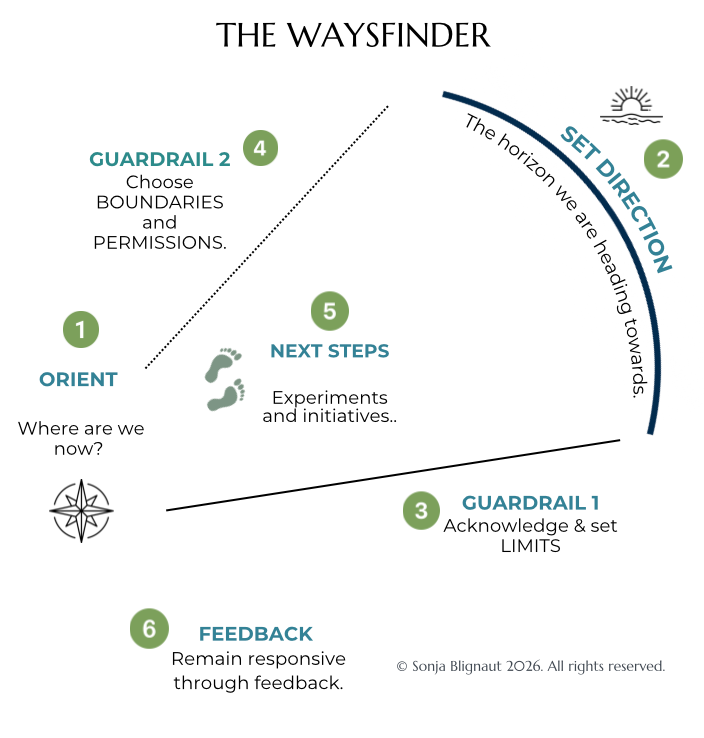
Four moves
Orient. Make sense of where the organisation actually is, not where the strategy deck says it should be or where the technology advocates want it to be.
Set intent. Establish clear direction aligned with the organisational strategy, rather than brittle goals that break on first contact with reality.
Create exploration spaces. Clarify guardrails and permissions. Give people room to act with genuine autonomy and agency, not “empowerment” that’s really just delegation with extra steps.
Notice and respond. Build the feedback loops that let you adjust continuously, instead of discovering you’ve drifted at the next quarterly review.
What we’ll explore together
The question around AI isn’t whether to adopt it. It’s adopting it with clarity as to the purpose: AI to what end?
Most AI initiatives focus on doing existing things faster and cheaper. That’s fine, as far as it goes. But it sidesteps the harder question: whether those things are worth doing at all, and whether the organisation is oriented well enough to benefit from doing them faster. That requires a different kind of thinking entirely. Starting from value rather than capability.
This workshop is built around the challenges leaders, coaches, and internal change agents are actually facing right now.
How do you keep moving forward without either freezing or reacting? The space between analysis paralysis and firefighting is narrow. WaysFinding gives you a way to move with purpose even when you can’t see the full picture.
How do you set strategy when planning can’t keep up? If every change triggers another adaptation, you never build momentum. Intent and guardrails solve this differently than traditional planning.
How do you handle the human side? AI adoption stalls because of fear, unclear roles, and contested ideas about what’s worth doing. Not because of technology. Leaders and coaches need tools for that complexity.
How do you lead when the ground keeps moving? AI isn’t another tool to deploy. It’s reshaping what organisations do, how they’re structured, and what leadership means. Most existing frameworks weren’t designed for this.
What you’ll leave with
One day won’t transform your organisation. But it can change what you’re able to see, help you orient and give you a sense of solid ground to move from.
Most leaders and coaches we work with aren’t lacking effort or intelligence. They’re lacking perspective. They’re too close to the terrain to read it.
This workshop is a balcony moment: a chance to step back, see the patterns, understand where the gaps actually are, and name what’s been happening in language that makes it actionable.
Specifically:
A clearer understanding of the difference between technical problems and adaptive challenges, and why it matters which one you’re actually facing. Best practices and expert maps work well in one. In the other, you need something different.
Why coherence matters more than alignment when the environment keeps shifting, and what that means for how you lead or advise.
How to orient in terrain that won’t sit still: reading what’s actually there rather than what the strategy deck assumed would be there.
The WaysFinder framework applied to your organisational AI context as a scaffold you can start using the following week, not abstract theory.
A way to set direction through intent and guardrails rather than goals and plans, and why this holds when detailed planning can’t keep up.
New language for what you’ve been experiencing. Sometimes that alone changes what’s possible.
This is not
An AI tools workshop. You won’t learn prompt engineering or how to deploy agents.
A strategy seminar. There’s no five-step transformation plan.
A theory lecture. Everything is applied. You work on real challenges, yours and each other’s.
This is an orientation workshop. A practical framework for setting direction, making decisions, and leading people through complexity that doesn’t resolve. Because that’s what this moment actually demands.
This is for you if
You’re responsible for leading an organisation or team through fast-paced, unpredictable transformation.
You’re an internal change agent trying to shift how your organisation or leadership navigates change, and you’re feeling the weight of that from the inside.
You’re a coach or consultant whose clients need support that your training didn’t prepare you for, and you want a practical framework you can actually bring into the room with them.
You’re tired of AI strategies that are really just tool adoption with better slide decks.
You don’t need to be technical. You need to be willing to think differently about what’s actually going on.
Your facilitators
Sonja Blignaut has spent 25 years working with organisations navigating genuine complexity – IKEA, Microsoft, Accenture, Electrolux, Barclays, across Africa, Europe, and Latin America. She developed WaysFinding from that work. She doesn’t hand you a recipe. She builds your capacity to navigate.
Michael Göthe is a leadership and organization coach and consultant at Crisp in Sweden. He’s applied WaysFinding in leadership programmes and transformation work across Scandinavian organisations, including the messy reality of AI adoption in teams. He brings the cases, the grounding, and the perspective of someone who’s used this framework in leadership, team, and organizational contexts.
What participants say
“I want to go out and try it right away with my leadership team. This is so helpful.” – Anna
“Moving from Dave Snowden’s work to this is a refreshing take. It’s already so accessible and usable.”
“Practical. I can start using the framework in my organisational context right away.” – Preben (LEGO)
“I learned a lot without being overwhelmed.” – Christine